
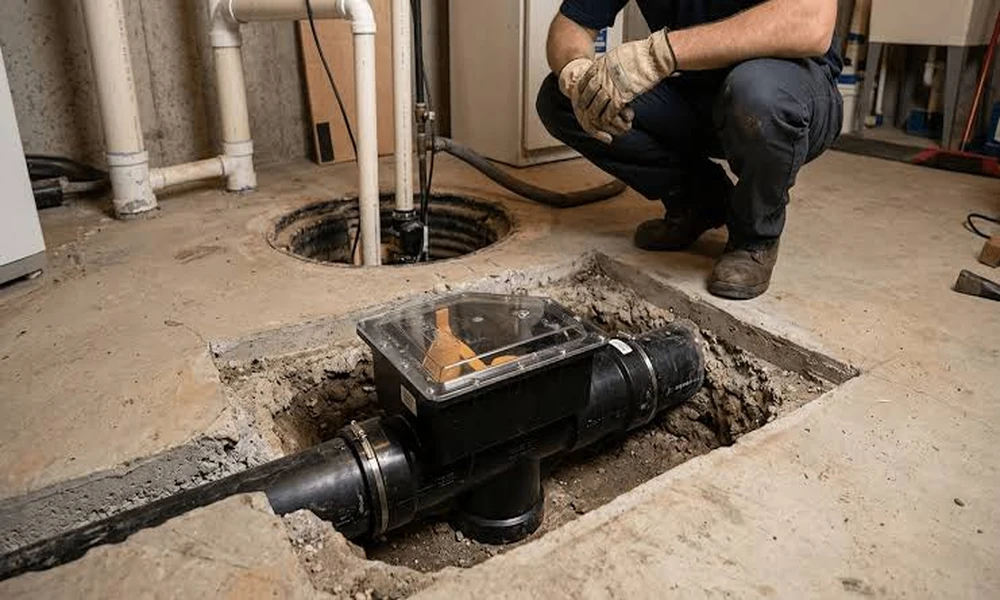
People tend to talk about backwater valves as if they were a single product you simply add to a house, the way you might add a smoke detector. Anyone who has watched a few go in knows better. The valve itself is a fairly simple part, a hinged flap inside a housing that lets wastewater leave and slams shut when sewage tries to come back. Everything around it is what changes from one home to the next, including where it sits, what has to be fixed before it can work, and how the family lives with it afterward.
The clearest way to understand that is to stop thinking about valves in general and look at specific houses. Northeast Ohio has a wide spread of housing ages, from early twentieth century doubles near the lake to postwar ranches and newer subdivisions farther south and west, and each era shapes the job in its own way.
Ask around the west side suburbs about who handles Cuyahoga County And Lorain County back water valve installation and the answer often leads to a shop on Eastland Road in Middleburg Heights. Carlong Plumbing runs camera inspections and digs its own excavations, so a job that starts in the basement can follow the lateral wherever it goes. Jamie has led that crew for roughly 25 years, and the company holds master plumber, sewer builder and backflow licenses under one roof.
With that in mind, here are three composite basements, the kind that show up again and again across both counties.
The Century Old Double Near the Lake
Picture a two family home built around 1920 on a narrow lot, the sort of house found all over the older inner ring. The basement floods every time a summer thunderstorm parks over the neighborhood, and the water that comes up the floor drain is unmistakably sewage.
Before anything else, a camera goes down the main cleanout, and it usually reveals two things at once. The first is a clay lateral with root intrusion at several joints. The second, which matters more, is that the clay footing tiles around the foundation drain straight into that same sanitary pipe, along with at least one downspout.
That second discovery reshapes the whole plan. A valve installed on this line would close during a storm and trap all of the groundwater coming off the foundation inside the house, so the basement would flood anyway. The work here happens in a deliberate order, and it goes roughly like this.
- The footing drains are cut off from the sanitary line and redirected into a new sump pit.
- A sump pump is set with its discharge running outside and away from the foundation.
- Downspouts are disconnected and extended onto the lawn.
- Roots are cleared and any broken clay sections are repaired or replaced.
- Only then is the valve installed on the sanitary main, with a cleanout cover left accessible on the floor.
It is the most involved of the three jobs and the most expensive, but skipping the early steps would make the valve close to useless. In a two family house there is one more conversation to have, because both households need to know that running water during a severe storm, while the flap is shut, sends that water nowhere but the basement.
The Postwar Ranch With a Finished Rec Room
Now move a few miles south to a brick ranch from the 1950s, the kind lining side streets across Parma, Brook Park and Middleburg Heights. Somebody finished the basement decades ago with paneling, carpet and a bar, and a single backup during an August storm ruined most of it.
Here the camera tends to tell a gentler story. The lateral is in decent shape, and the footing drains may already empty into a sump. The real constraint is space. Cutting a hole in a finished floor means pulling up flooring, moving furniture, and choosing a location that will stay reachable for years, since the valve needs to be opened and checked once or twice annually. A valve buried under a new laminate floor with no access lid is a valve that will never be maintained.
Many owners in this situation decide to put the valve outside instead. An excavator opens a trench in the front yard over the lateral, the valve goes in with a riser that comes up to a cap at ground level, and the finished basement is never touched. The trade is a torn up patch of lawn and a higher price in exchange for a rec room that stays intact.
There is a lesson buried in this house that applies elsewhere. The cost of a valve job is rarely about the valve. Nearly all of it is about reaching the pipe, and that depends on depth, floor finishes and what is sitting above the line.
The Newer Home Out Past the County Line
The third basement belongs to a newer house in the growing parts of Lorain County, where subdivisions have spread out from older cities like Elyria and Lorain. The plumbing is PVC, the footing drains discharge to a sump or a separate storm line, and the home has never flooded.
So why install a valve at all? Usually because a neighbor’s basement backed up, or the owner is finishing the lower level and wants protection before spending thousands on drywall. Plumbing on these homes is often straightforward, and a valve can be set during the finishing work, before the floor is covered, which is the cheapest and easiest moment it will ever be.
The homeowner’s biggest task here is research rather than construction. Some cities have programs that help pay for this kind of protection. Elyria, for example, offers a zero percent loan for sewer lateral work that includes backflow check valves, footing drain repair and downspout disconnection, repaid over ten years through the county auditor. Programs like this almost always require an evaluation and multiple estimates before work begins, so the paperwork has to come first.
What the Three Have in Common
Set the three houses side by side and a pattern appears. None of these jobs started with the valve. Each started with a camera, a look at where the groundwater goes, and an honest answer about why the basement was flooding in the first place. That is why two quotes for what sounds like the same work can be thousands of dollars apart, since one contractor may have scoped the line and found the tied in footing drains while the other simply priced a part and a patch of concrete.
Permits and inspections apply in all three cases, and in parts of Cuyahoga County the contractor must also be registered with the county before touching a sanitary lateral. Every one of these homeowners also inherits the same small responsibility once the job is done. The flap has to be kept clean, the access cover has to stay reachable, and the household has to remember to go easy on the faucets when the street floods.
A good valve installation feels anticlimactic in the end. The rain comes, the street drains struggle, and the basement simply stays dry, which is exactly the point.