
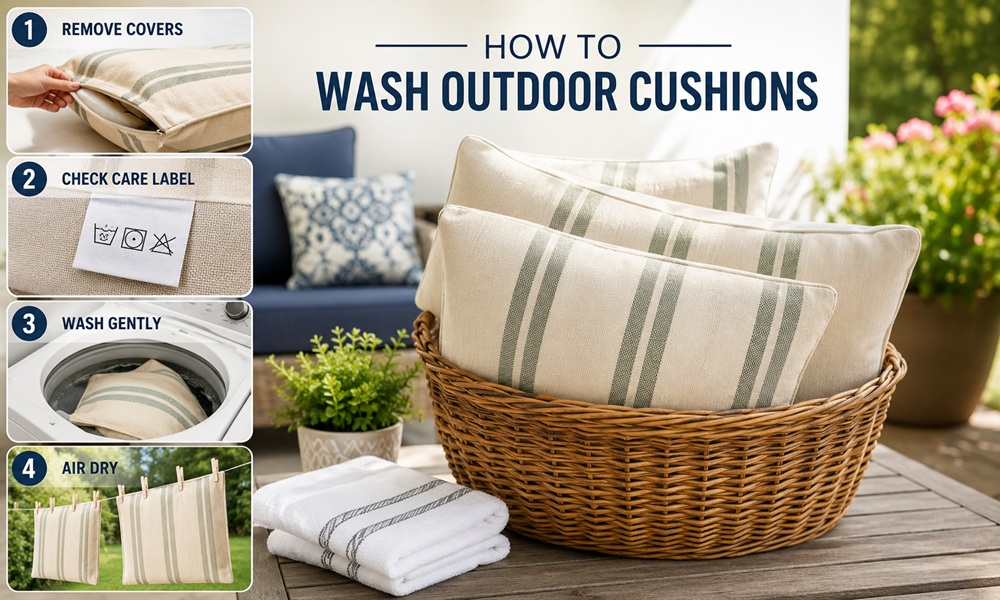
Outdoor cushions take a beating. Sun, rain, pollen, food spills, and the slow creep of mildew all leave their mark.
Most people either scrub too hard and fade the fabric, or reach for a pressure washer and force mold deeper into the foam. Both make the problem worse.
The right method depends on your fabric and how bad the grime is. Here is the full playbook, from a quick refresh to reviving a mildewed cushion, without wrecking the fabric.
Step one: read the care tag and pick your method
Everything starts with the label. It tells you what your fabric can survive.
Use this decision path.
- Removable, machine-washable cover? Machine wash cold on a gentle cycle. Zip covers closed first to prevent snagging.
- Removable but not machine-safe? Hand wash the covers.
- Fixed cover you cannot remove? Spot clean the whole cushion by hand and dry it thoroughly.
- Natural fiber like cotton? Be gentle and skip bleach. It fades and weakens the fabric.
- Performance fabric like acrylic or olefin? More forgiving, and can usually handle a diluted bleach solution for stubborn mildew.
Whatever the method, spot test any cleaner on a hidden corner first to make sure it does not fade the color.
How do you machine-wash outdoor cushion covers?
If the tag allows it, this is the easiest route.
- Unzip and remove the covers. Set the foam inserts aside in a dry spot.
- Zip the covers closed so they do not snag or stretch.
- Wash cold, on a gentle or delicate cycle, as their own load in case of pollen and dirt.
- Add 1 cup of white vinegar to the softener dispenser to freshen and fight mildew. Skip fabric softener.
- Air-dry on a line unless the tag says the cover is dryer-safe.
How do you hand-wash cushions that cannot go in the machine?
Most cushions fall here. It is simple and gentle.
- Brush off loose dirt. Vacuum fixed covers to lift debris.
- Mix a cleaning solution (see the chart below).
- Apply with a soft-bristle brush or cloth. Work in small circular motions.
- Let it sit about 5 to 15 minutes so it can lift the grime.
- Rinse thoroughly with a garden hose until the water runs clear. Leftover soap attracts dirt.
- Press out excess water, blot with a towel, and stand the cushion on edge to dry.
Which cleaning solution should you use?
Match the mix to the mess and the fabric.
| Solution | Recipe | Best for | Caution |
|---|---|---|---|
| Mild soap | 1 tbsp dish soap in a bucket of warm water | General dirt, routine cleaning | Safe on most fabrics |
| Vinegar spray | 50/50 white vinegar and water | Mild mildew, odors, eco-friendly clean | Test first; may not clear heavy mold |
| Borax boost | Add 1/4 cup borax to soapy water | Mildew-prone cushions | Rinse well |
| Diluted bleach | Per product guidance | Stubborn mildew on olefin/acrylic | Never on natural fibers; no fabric softener |
| Oil-stain lift | Cornstarch or baking soda | Grease and oil spills | Let sit, then scrape off before washing |
For everyday upkeep, a mild soap solution is enough. Save vinegar, borax, or bleach for actual mildew.
How do you remove mold and mildew from outdoor cushions?
Mildew is the most common cushion problem, and the most fixable if you act early.
- Take the cushions to an open, well-ventilated area. Brush off surface mold.
- Choose your solution. Vinegar works for light mildew. Diluted bleach handles deep-set mold on synthetic fabrics.
- Apply generously to the affected spots. Let it sit about 5 minutes to an hour for tough patches.
- Scrub gently with a soft brush in circular motions. Aggressive scrubbing wears the fabric.
- Rinse thoroughly with a garden hose until all cleaner is gone.
- Dry fully in direct sun. Flip the cushions through the day so both sides dry.
Do not stack or store them until they are bone dry.
Insight most guides skip: the pressure washer trap and the sun trick
Two things separate a good clean from a ruined cushion.
Never pressure-wash the foam inserts. It is tempting, but high pressure forces mold and water deeper into the fill and can damage seams and fabric. If you use a pressure washer at all, keep it to a low setting on furniture frames or wicker, never on cushion inserts. Some sources allow low-pressure rinsing of covers, but the fill is off-limits.
Sun is a free disinfectant. Direct sunlight does more than dry cushions. It naturally kills lingering bacteria and lifts musty odors. Drying flat in a sunny, breezy spot is the single best finishing step, and it usually takes 4 to 8 hours depending on thickness and humidity.
Bleach is fabric-specific. Performance fabrics like acrylic and olefin can usually take a diluted bleach solution. Natural fibers like cotton cannot; bleach fades and weakens them. Know your fabric before you reach for it.
How do you treat specific stains?
Catch the spill early. Blot, do not rub.
- Oil or grease: Cover with cornstarch or baking soda, wait 10 to 15 minutes, then scrape off before cleaning.
- Food and drink: Blot up excess immediately, then spot clean or wash.
- Wine: Blot fast, then treat with a targeted stain remover made for outdoor fabric.
- General mildew stains: Vinegar or, on synthetics, diluted bleach.
How do you prevent mildew from coming back?
Prevention beats scrubbing every time.
- Never store cushions damp. Let them dry completely first.
- Deep clean before off-season storage and store in a dry place.
- Apply a UV- and water-resistant protective spray.
- Choose mold-resistant performance fabrics for replacements.
- Blot spills the moment they happen, before they set.
Frequently asked questions
Can you put outdoor cushions in the washing machine? Only if the covers are removable and the tag says machine-washable. Wash cold on gentle, zip them closed, and skip fabric softener. Otherwise hand-clean.
How do you get mildew out of outdoor cushions? Spray a 50/50 vinegar-and-water mix, or a diluted bleach solution on synthetics, scrub with a soft brush, rinse with a hose, and dry fully in the sun.
Can you use bleach on outdoor cushions? On synthetic fabrics like acrylic and olefin, a diluted bleach solution is usually safe. Never use bleach on natural fibers like cotton, as it fades and weakens them.
Can you pressure-wash outdoor cushions? No, not the foam inserts. Pressure forces mold deeper and damages seams. Use low pressure only on frames or wicker.
How long do outdoor cushions take to dry? Usually 4 to 8 hours in direct sun, depending on thickness and humidity. Always dry them completely before storing to prevent new mildew.