
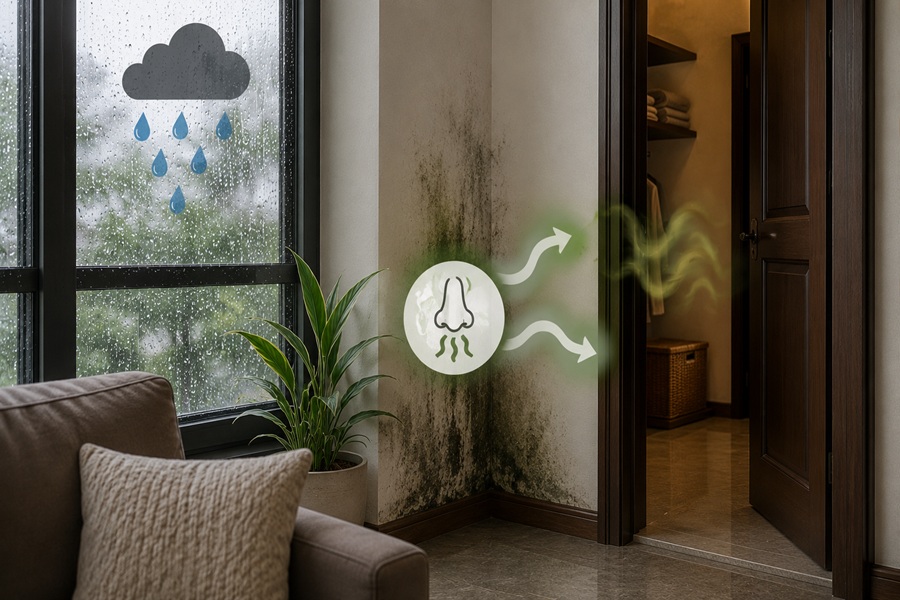
The rain starts, and within an hour one room in your house turns musty. No puddle, no visible leak, nothing new. Just that damp, earthy, basement-like smell that was not there yesterday.
It feels random. It is not. Rain changes the humidity, pressure, and airflow in your home in specific ways, and certain rooms react more than others.
That smell is telling you something. Here is what, and where it is coming from.
First, is it the good rain smell or the bad one?
Two very different smells get confused here.
The pleasant, earthy scent of rain outdoors is called petrichor. It comes from natural compounds in soil and plants released when rain hits the ground. That smell is harmless and, to most people, nice.
The musty, stale, damp smell that shows up inside one room is different. It is not petrichor drifting in. It is moisture interacting with materials and, often, with mold or mildew inside your home. That smell is a signal worth paying attention to.
This article is about the second one.
Why does rain make indoor smells worse?
Several things happen at once when it rains, and together they explain the sudden musty smell.
Humidity reactivates dormant mold and mildew. Mold spores are always in the air. They stay quiet until they find moisture. When rain raises indoor humidity, spores in damp, enclosed spaces wake up and start producing that musty odor. You may smell it before any mold is visible.
Porous materials release trapped odor. Walls, drywall paper, wood, carpet, furniture, and stored fabrics all absorb small amounts of moisture over time. When humidity rises after rain, these materials release that moisture along with the odor molecules held inside them. This is why the smell can feel widespread and seem to come from nowhere.
Pressure changes push out trapped air. Storms shift atmospheric pressure. Those shifts move air inside your walls, and stale, musty air trapped in wall cavities, crawlspaces, and basements gets pushed out into your living space. The effect is temporary but very noticeable.
Saturated ground raises humidity below. Rain soaks the soil around your foundation. That moisture raises humidity in basements, crawlspaces, and slab edges, which then rises into the rooms above.
Your HVAC can spread it. If there is dampness or mold in the ducts, coils, or drain pan, running the system circulates that smell to every room. Rain and humidity increase the moisture load the system handles, making it worse.
The scent-source map: what the smelly room is telling you
The single most useful clue is which room smells strongest. It points you toward the source. Use this map.
| Where the smell is strongest | Most likely source | What to check |
|---|---|---|
| Bathroom | Drain, toilet seal, or hidden moisture | Toilet base, tub and shower drain, vanity cabinet, nearby walls |
| Laundry room | Drain, washer box, humidity | Washer standpipe, floor drain, wall behind the washer |
| Kitchen | Under-sink leak or drain | Cabinet floor for staining or swelling, trap, disposal, supply lines |
| Basement or lower level | Foundation moisture, poor drainage | Foundation cracks, sump area, corners, wall base |
| One upstairs room or ceiling | Roof leak wicking into insulation | Attic above the room, ceiling for faint staining |
| Every room at once | HVAC system | Ducts, evaporator coil, drain pan for mold or standing water |
| Enclosed rooms with poor airflow | Trapped humidity | Closets, storage rooms, corners behind furniture |
Lower levels and enclosed rooms almost always smell first, because they are cooler, less ventilated, and closer to ground moisture.
The outside causes that feed the smell
Very often the trigger is outside the house, moving water where it should not go.
Clogged gutters. When gutters fill with debris, rainwater overflows and pools against the foundation instead of draining away. Over time that moisture works into walls and crawlspaces. Clearing gutters is one of the simplest fixes.
Poor drainage and grading. If the ground slopes toward the house, rain pools at the foundation and seeps in. Soil should slope away from the house.
Foundation cracks. Small cracks let water and damp air infiltrate the lower level, bringing the musty smell with them.
Roof and flashing gaps. Roof leaks do not always drip. Sometimes they wick or mist moisture into insulation, where it sits until airflow pushes the smell down into a room.
How do you get rid of a rain-triggered musty smell?
Treating the smell without the moisture source just means it comes back. Work in this order.
- Find the source. Use the room map above to narrow it down. Follow the strongest smell.
- Fix the water path. Clear gutters, correct grading so water drains away, seal foundation cracks, and repair any roof or plumbing leak you find.
- Dry it out and dehumidify. Lower indoor humidity to roughly 40 to 50 percent with a dehumidifier. If the smell improves noticeably over several days to a couple of weeks with dehumidification, that is strong evidence the problem is moisture-driven, even without visible mold.
- Ventilate. Improve airflow in enclosed rooms. Run exhaust fans in bathrooms and laundry areas. Open windows when the weather is dry.
- Service the HVAC. If the smell is house-wide, have the coils, drain pan, and ducts checked for moisture and mold.
A quick way to confirm a moisture cause: run a dehumidifier in the affected room for a week or two. Steady improvement means moisture is the culprit and you can focus your search there.
When should you call a professional?
Bring in a pro when:
- The smell keeps returning after every rain despite your fixes.
- It gets stronger over time.
- You see staining, soft drywall, or visible mold.
- You suspect a foundation, roof, or plumbing source you cannot reach.
A musty smell after rain is rarely an emergency, but it does mean moisture is staying where it should not. Finding it early keeps a small problem from becoming a large repair.
Frequently asked questions
Why does my house smell musty only when it rains?
Rain raises indoor humidity and shifts air pressure, which reactivates dormant mold, releases odor from damp materials, and pushes stale air out of wall cavities and crawlspaces. If the smell appears only with rain, hidden moisture is almost always involved.
Does a musty smell always mean mold?
Not necessarily. The odor often appears before mold is visible, from damp dust, moist materials, and microscopic growth. But it is a reliable early signal of a moisture imbalance worth investigating.
Why does only one room smell and not the others?
Because that room is closest to the source, or is more enclosed and humid. Lower levels, bathrooms, laundry rooms, and rooms under a roof leak react first. The strongest-smelling room points you toward the cause.
Can clogged gutters cause a musty smell indoors?
Yes. Overflowing gutters dump rainwater against the foundation, where it seeps into walls and crawlspaces and creates persistent dampness. Clearing gutters and directing water away is a common, simple fix.
Will an air freshener fix a musty rain smell?
No. It only masks it. The smell comes from moisture and possibly mold, so it returns every time it rains until you find and fix the water source and dry the space out.