
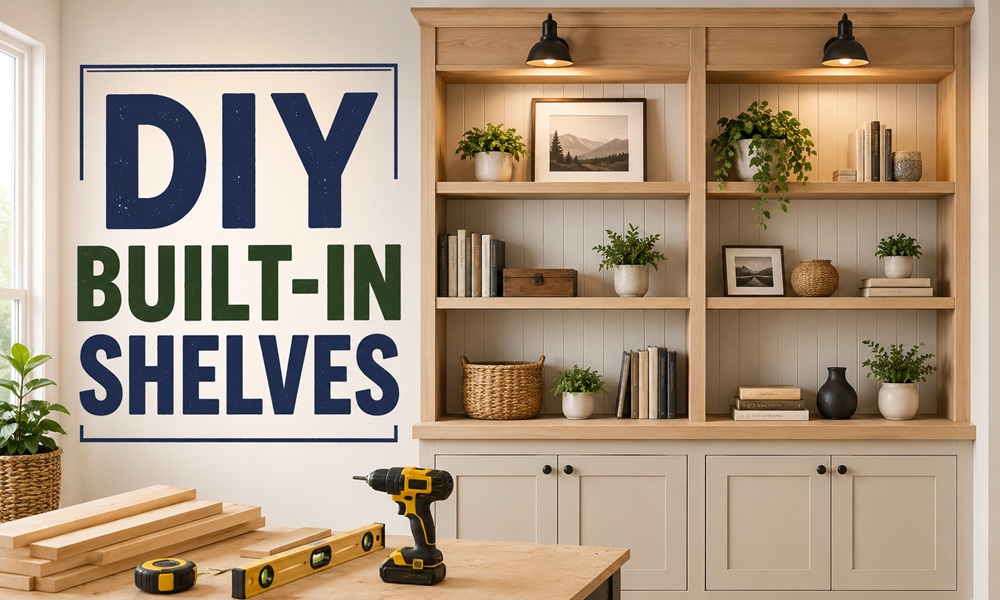
Built-in shelves turn dead wall space into the best feature in a room. They add real storage and read as a permanent, custom upgrade.
Hiring that out is not cheap. Professional built-in bookshelves typically run $1,400 to $4,800, with most homeowners spending around $3,000. Truly custom work is priced like cabinetry, often $100 to $1,200 per linear foot.
Building them yourself can cut that dramatically. The catch is that “built-in” means fit to your exact wall, and walls are rarely square. This guide covers the real cost, the cut list, and the two skills that make DIY built-ins look professional instead of homemade.
Quick answer: To build DIY built-in shelves, measure the space and build a base frame, cut side panels and shelves to 1 inch short of the ceiling, drill adjustable shelf-pin holes, assemble the box, then anchor it into wall studs and scribe the trim to the wall. Finish with a face frame for a seamless custom look.
Should you DIY or hire a pro?
Be honest about the trade. DIY saves the most on materials and labor, but built-ins demand accurate measuring and patience with an uneven wall.
| Route | Typical cost | Time | Best for |
|---|---|---|---|
| DIY floating shelves | Under $100 per set | A few hours | Beginners, small displays |
| DIY built-in bookcase | $150 to $600 in materials | 1 to 2 weekends | Confident DIYers |
| Hire a carpenter | $1,400 to $4,800 | Days to weeks | Full walls, complex trim |
| Custom cabinetry | $100 to $1,200 per linear foot | Weeks | High-end, code-compliant work |
A pro brings code compliance, safe anchoring, and a finish that matches the room. The DIY win is cost, if you are willing to sweat the fit.
What tools and materials do you need?
Materials
- Quality plywood or dimensional lumber for sides and shelves
- Lumber for the base frame and face frame
- Wood glue, screws, finishing nails
- Wood filler and caulk
- Primer and paint or stain
- Shelf pins for adjustable shelves
Tools
- Tape measure (a laser measure adds precision)
- Circular saw, table saw, or miter saw
- Drill and a shelf-pin jig
- Stud finder
- Level and a carpenter’s square
- Nail gun (optional but faster)
Pick lumber that will not sag or warp under sustained weight. Sagging shelves are the number one long-term complaint.
Insight most guides skip: the two skills that sell the look
Two details separate a real built-in from a bookcase pushed against a wall.
The 1-inch rule. Build the unit about 1 inch shorter than your ceiling height. That gap lets you tilt the assembled unit upright into place. You close the gap later with crown molding or trim, which is also what makes it read “built-in” rather than freestanding.
Scribing to the wall. Walls bow and corners are rarely 90 degrees. If you butt a straight panel against a wavy wall, you get an ugly gap. Scribing means marking the wall’s actual contour onto your trim and cutting to match, so the unit hugs the wall seamlessly. This one step is why store-bought shelving always looks like an add-on and a true built-in does not.
Do these two things and even a modest plywood box passes for custom cabinetry.
How do you build built-in shelves step by step?
Work through it in phases. Do not skip the measuring.
Phase 1: Measure and prep
- Measure height, depth, and width of the space. Measure in several spots, since walls vary.
- Plan the unit height to 1 inch short of the ceiling.
- Remove baseboards and any crown molding where the unit will sit so it can slide flush to the wall.
Phase 2: Cut the parts
- Cut the base frame, the two side panels, and the shelves. Cut shelves in matched pairs for consistency.
- Drill adjustable shelf-pin holes in both side panels. Use a jig so the holes line up and shelves sit level.
Phase 3: Assemble
- Build and level the base frame first. A level base means level shelves.
- Attach the side panels to the base and add the top shelf to lock the box square.
- Prime and paint the interior now, while you have easy access.
Phase 4: Install and finish
- Tilt the unit into place. Find the studs and screw the frame securely into them. Anchoring into studs is a safety must, not optional.
- Scribe and attach trim where the unit meets the wall and ceiling.
- Add a face frame across the front to hide raw plywood edges and give a finished, cabinet-grade look.
- Fill nail holes, caulk seams, and apply the final coat of paint.
Want the easy version? Floating shelves
If a full built-in feels like too much, floating shelves deliver a similar clean look with far less commitment. A common method:
- Cut a thick board to length and sand it smooth.
- Drill holes into the back edge for dowels, or build a hidden cleat.
- Locate the wall studs and mount a support cleat into them.
- Slide the shelf onto the cleat and secure with glue or screws.
Many builders finish a set of floating shelves in an afternoon for under $100.
What do first-time builders get wrong?
DIY and woodworking communities repeat the same lessons:
- Measuring once. Walls are not square. Measure in multiple spots and account for the variation.
- Ignoring the wall contour. Straight panels against wavy walls leave gaps. Scribe the trim.
- Under-anchoring. Shelves loaded with books must be screwed into studs. Wall anchors alone are not enough.
- Cheap, thin shelves. Long spans of thin material sag. Use thicker stock or add support for wide shelves.
- Skipping the face frame. Raw plywood edges are the giveaway. A face frame hides them.
Frequently asked questions
How much does it cost to build DIY built-in shelves?
Materials for a DIY built-in bookcase often run $150 to $600, versus $1,400 to $4,800 to hire a pro. Custom cabinetry is priced around $100 to $1,200 per linear foot.
What wood is best for built-in shelves?
Choose sturdy plywood or dimensional lumber that resists sagging and warping under weight. Avoid thin, flexible boards for long spans.
How do you attach built-in shelves to the wall?
Anchor the frame into wall studs with screws. Locate studs with a stud finder first. Anchoring into studs is essential for safety.
Why do my built-in shelves have a gap against the wall?
The wall is not perfectly straight. Scribe your trim to the wall’s actual contour and cut to match so the unit sits flush.
Are floating shelves easier than built-ins?
Yes. Floating shelves can be built in an afternoon for under $100 and require far less fitting than a full built-in unit.