
“Duplex townhouse” is not a real classification. Neither is “duplex condo.”
The words get used interchangeably in listings, and the differences aren’t cosmetic — they change who owns the land, who pays for the roof, what loan you qualify for, and whether you can legally rent it out.
This is a definitions guide. It draws a hard line between structure, ownership and zoning, because those three things are constantly confused.
Start Here: The Three-Question Test
Before any label, answer these:
| Question | If yes… | If no… |
|---|---|---|
| 1. Is the whole building sold as one asset? | Duplex / multi-family | Townhouse or condo |
| 2. Does each unit sit on its own separately titled lot? | Townhouse, twin home or semi-detached | Duplex |
| 3. Does the property share walls with more than one neighbour? | Townhouse / rowhouse | Duplex |
Everything below is elaboration on those three questions.
What Is a Side by Side Duplex?
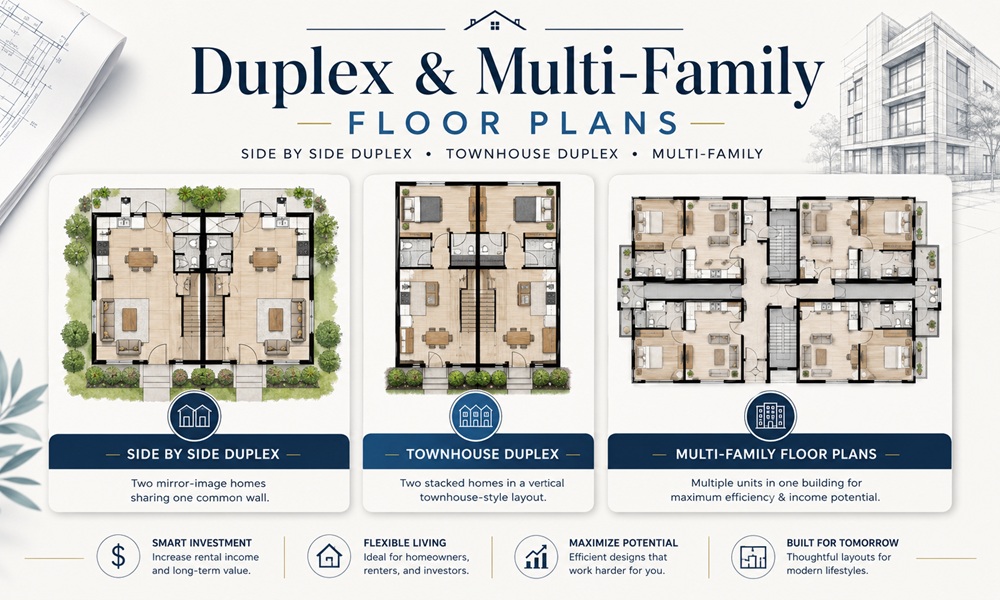
A side by side duplex is one building, on one lot, containing two complete dwellings separated by a vertical party wall.
In a side-by-side duplex the shared wall sits in the middle. In an up-and-down duplex, the dividing “wall” is the floor and ceiling between units.
Defining features:
- One lot. One title. One owner. With multifamily homes such as a duplex, all the dwellings are sold together. If you buy a duplex, you get both sides.
- Two separate entrances, kitchens, bathrooms and living areas.
- Separate utility meters in almost all purpose-built plans.
- Duplexes typically have more windows and doors than townhouses, because only one interior wall is shared — leaving three walls free.
The Four Side-by-Side Sub-Types
| Sub-type | Wall shared | Typical storeys | Lot shape |
|---|---|---|---|
| Classic side-by-side | Vertical, central | 1 or 2 | Wide |
| Front-to-back | Vertical, perpendicular to street | 1 or 2 | Deep, narrow |
| Stacked / unit-over-unit | Horizontal (floor/ceiling) | 2 | Narrow |
| Back-to-back | Rear wall, with opposite front entries | 1 or 2 | Deep |
Why the Side-by-Side Dominates
Two mirror-image units sharing one structural wall, each with a separate front entrance facing the street, is the most commonly built and most easily rented duplex format in the USA. The shared wall reduces framing and insulation costs without compromising either tenant’s privacy.
What Is a Townhouse Duplex — and Does It Exist?
Strictly, no. The term is a hybrid people use for a two-unit building with townhouse-style vertical units.
A duplex townhouse isn’t a real classification. A duplex refers specifically to a two-unit structure, while a townhouse is one unit in a row of multiple homes.
What people usually mean by “townhouse duplex” is one of two things:
- A two-storey side-by-side duplex where each unit occupies the full height of the building — the townhouse form, the duplex ownership. Plan books sometimes call this “townhouse style.” Side-by-side duplexes (townhouse style) share a party wall and suit standard-width lots, offering equal frontage.
- A pair of townhomes — two attached homes on two separate titles. That’s a semi-detached, twin home or duet home, not a duplex.
Duplex vs Townhouse: The Real Differences
| Dimension | Side by side duplex | Townhouse |
|---|---|---|
| Ownership | Two homes in one building owned by one individual | Individually owned |
| Number of shared walls | One | Usually two (one if an end unit) |
| Land | Both units on the same lot | Unit and land beneath owned individually |
| HOA | Normally none, because there is just one owner | Usually yes; HOA handles exterior maintenance |
| Zoning treatment | Typically two-family or multi-family | Often treated like a single-family home |
| Exterior maintenance | Property owner is responsible for all of it | Often HOA-managed and funded by dues |
| Rental freedom | Full | HOA rules may limit rental use |
| Windows and light | More | Fewer — windows typically front and back only |
| Outdoor space | Possible yard on front, back and/or side | Limited to front and back |
| Typical price | Usually costs more than a townhouse, but one side can be rented | Lower entry price |
| Layout orientation | More horizontal | More vertical, across multiple floors |
The One That Trips Everyone Up: The Duet Home
A duet home looks identical to a duplex from the street. It is an attached single-family home — one unit that you can purchase, with each side sold separately, more like a townhouse with just two units.
The shortcut: does one person, couple or family own both living units? If yes, it’s a duplex. If each side has its own owner, it’s a duet or twin home. The preliminary title report settles it. County records sometimes don’t.
What Counts as Multi-Family — and Where Does a Duplex Sit?
Multi-family is the umbrella. Duplex is one item under it.
The term “duplex” is not extended to three- and four-unit buildings; those are three-family (triplex) and fourplex (quadplex), or more generally, a multiplex.
| Units | Common name | Residential financing? |
|---|---|---|
| 2 | Duplex / two-family | Yes |
| 3 | Triplex / three-family | Yes (1–4 unit rule) |
| 4 | Fourplex / quadplex | Yes |
| 5+ | Small multi-family / apartment | No — commercial financing |
The 1–4 unit line is the most financially important boundary in residential real estate. Buy a multifamily property of four or fewer units and plan to live on-site, and you can use an FHA loan with a low down payment, or a VA loan with no down payment if eligible. Cross to five units and you’re in commercial lending.
The line between an apartment building and a duplex is somewhat blurred; apartment buildings tend to be bigger, while duplexes are usually the size of a single-family house.
Why Do Cities Define “Duplex” Differently?
Because zoning codes were written locally, decades apart, and nobody coordinated.
This is the section almost no competing article covers — and it’s the one that determines whether your plan gets approved.
| Jurisdiction | Term used | Definition |
|---|---|---|
| Dallas | Duplex | Two dwelling units located on a lot |
| Philadelphia | Duplex dwelling | A dwelling occupied as the home of two families, under one roof, each family occupying a single unit — a definition that excludes a pair of twin (semi-detached) houses |
| San Francisco / Vancouver | Two-family dwelling | No specification of the physical relationship between units |
| Winnipeg | Dwelling, two-family | As above |
| Buffalo, Detroit, Chicago | Two-flat | A residential building containing two dwelling units on a single lot |
| Edmonton | Duplex housing | One principal dwelling placed over another within a single building, each with separate and individual access |
| Calgary | Duplex dwelling | A building containing two dwelling units, one located above the other, each with a separate entrance |
Read those last two again. In parts of Canada, a “duplex” is by definition stacked — what an American builder would call a side-by-side is something else entirely.
And Outside North America
In Australia, a duplex is generally a residential building containing two homes sharing a common central wall, usually mirror images of each other. In South Australia the term maisonette is also used. Back-to-back duplexes share a rear wall with opposite front entries.
In parts of the Northeastern United States, Western Canada and Saudi Arabia, “duplex” is also used for two attached units on two distinct properties — which most planners would call semi-detached or twin homes. Some jurisdictions call these paired homes.
Practical takeaway: before you buy plans, read your municipality’s own definition. The word on the plan cover means nothing until it matches the word in the bylaw.
Which Floor Plan Type Should You Choose?
Decision Matrix
| Your goal | Best fit | Why |
|---|---|---|
| Live in one, rent the other | Side by side duplex | Live in one unit and rent out the other for consistent income |
| Lowest maintenance ownership | Townhouse | HOA handles exterior upkeep |
| Maximum rental income per lot | Fourplex | Four rent cheques, still residential financing |
| Multigenerational family | Side by side duplex | Multi-generational living with partitioned spaces — family close yet independent |
| First-time buyer, low budget | Townhouse | Often the more affordable and manageable option |
| Build equity fastest | Duplex | May help build equity faster through rental income |
| Narrow urban infill lot | Stacked duplex | Smallest footprint per unit |
| Aging in place | Single-storey side by side | No stairs |
The Honest Trade-Off
A duplex offers more flexibility for investment or multi-generational living. A townhouse is great for lower-maintenance living in a planned community. Duplexes are better for income and space; townhouses are designed for convenience and simplicity.
Duplexes offer more rental income potential, but require more maintenance and management. Duplex owners are responsible for maintenance similar to a single-family home.
What Do Owners Actually Report?
Patterns from homeowner and investor discussion on Reddit (r/RealEstate, r/realestateinvesting), Quora property threads, and first-person Medium accounts:
- The single shared wall beats two. Duplex owners who previously lived in townhouses consistently mention the noise difference from having neighbours on one side instead of two.
- “No HOA” cuts both ways. Duplex owners celebrate the absence of dues, then discover they now personally own the roof, the siding, the driveway and the tree that fell on it.
- The stacked duplex has a stairs problem. Investor threads report longer vacancy on upper units and note that ground-floor units in stacked duplexes command a premium.
- Title confusion is common at closing. Buyers routinely discover late that what the listing called a duplex is actually two separately titled twin homes. The preliminary title report is the document that resolves it.
- Townhouse HOA rental caps blindside investors. Multiple accounts describe buying a townhouse to rent, then finding the association caps the number of leased units.
Frequently Asked Questions
Is a duplex the same as a two-family home? Functionally yes. San Francisco, Vancouver and Winnipeg use “two-family dwelling” in their codes rather than “duplex.” The legal term varies; the structure is the same.
Is a duplex considered multi-family? Yes. A duplex is considered a multi-family dwelling consisting of two apartments. It is commonly called a multi-family property because more than one family can live in it.
Can two people own one duplex? They can co-own it, but they own it together — the building isn’t legally divisible unless it’s condominiumised or the lot is split. One owner (or set of owners) owns both sides. Splitting a duplex into two titles typically requires a subdivision or condo plat.
Do duplexes and townhouses share a wall? Both do. Duplexes share one common wall between the two units on the same lot. Twin homes also share a wall, but sit on different lots. Townhouses usually share two.
Is a side by side duplex better than a stacked duplex? For build cost per foot, stacked wins. Side-by-side duplexes cost $160 to $280 per square foot depending on storeys; unit-over-unit runs $150 to $190. For rentability, equal-access and resale, side-by-side generally wins.
Which is better for rental income: duplex or townhouse? A duplex offers stronger income potential with two separate units. Townhouses may have HOA rules limiting rental use.
Are duplexes cheaper than single-family homes? The project cost of a duplex build is generally less than that of a single-family home per unit delivered, though the total ticket is higher because you’re building two homes. Generally speaking, duplexes and townhouses are less expensive than detached single-family homes.